Wednesday, October 16, 2013

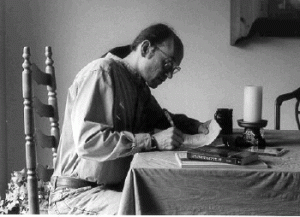
A Sickness I Want: An Interview with Sam Rasnake


Sheldon Lee Compton: Why do we write, Sam? Why in the world do we write?

Sam Rasnake: I used to think we write because we have something to say, but that’s not strong enough. “Having something to say” is a dream – a Burmese tiger pit – fool’s gold – rationalization ... but it’s not passion. The real reason should be belly-deep. There’s the passion. We write out of need. We write because we’re not whole – something is missing. Here are some lines from Mark Strand – “Keeping Things Whole” – the first stanza: “In a field I am the absence of field. This is always the case. Wherever I am I am what is missing.” – I write because something is missing. When I write, I hope – pray even – the words will find completion, some sort of wholeness – put me dead center. Of course, they never do, but that is what the writing strives for – if I don’t interfere. “Something is missing” and the words are bringing it back. A work with no end. Someone might say “Money”. Fine. The money is
missing. We write for money. What about “Fame”? Ok - we have no fame – we want it. Name in lights. Or, here’s my reason – as my Dad would say – “ad infinitum ad nauseam.” We work...we write until we’re sick of it. That’s a sickness I want. I don’t ever want to be rid of it.


SLC: The idea that something is missing is a fine one, Sam. Those of us who don't write to make a living can relate, I believe. I once tried to stop writing and found myself breaking over when I scribbled some captured dialogue on a napkin while eating. I love this sickness, as well. As a storyteller, poet, writer, keeper of the tale, how much obligation is at play for you? Do you feel as if there is a reason beyond your own enjoyment to continue crafting words?

SR: I've never made my living by my writing - but I've also never considered writing to be a hobby or to hold a secondary place in my life. Writing is more connected with who I am than with something I do. For this reason I feel obligated to the writer in me - obligated to the writing in me. Maybe I should say the writing left in me. I know there's an end to it - but like Townes Van Zandt who said he'd designed his life to end before the writing did - I hope I never reach the end of my own writing. The negative is I can never outlive all I need to write - and the positive, there will always be more I need to write. No end. There's my obligation. If the possibility of publication vanished, I would, in most ways, feel more free, for one, to finish my Ulysses project. I could let go of the rounds of submissions and waiting, submissions and waiting - and be able to focus more directly on the creative part of the writing process. I would be free of the publication path - It's a good path. I do believe that - but it's still a path, and the forest is out there - off the path - uncharted. I know I'd keep writing. I like and enjoy publication of individual works and collections, but that's not why I write.

SLC: So what do you have going on lately, Sam? I know you're latest work, Cinéma Vérité, is out from A-Minor Press, but I haven't had the chance to read it yet. Can you talk some about it here?


 SR: Cinéma Vérité is a collection of poems focused on or in reaction to a wide range of films. The book is part three in a six-part series – Tales of Brave Ulysses – that contains works that are ekphrastic in nature in the poetry’s connection to other art forms. I began the series years ago – Religions of the Blood (Pudding House Press) serves as an introduction, and Inside a Broken Clock (Finishing Line Press), poems connected to literature. Film is one of my passions, so writing about various works was a natural move for me. The majority of poems in Cinéma Vérité were written over the last three years. Various poetic forms and approaches are represented in the works – from sonnet variations to open forms to prose poems, from narrative to contemplation to theme. I do indicate a wider approach on the title page by stating that the book’s readers will encounter poems, parables, and sketches. This grouping – which will be even more pronounced in The Divination of Sticks, the final part of the Ulysses series – is influenced by my love for the writings of Jorge Luis Borges – specifically his book El Hacedor (Dreamtigers). Borges’ works move fluid-like between closed and open poetic forms, between poetry and the prose of parables and flash fiction. That is clearly an influence in the pieces found in Cinéma Vérité. During the next month or so I plan to work on shaping the next part of the series – World within the World – poems connected to art. Most of the pieces are written and have been published in various magazines, but I’m still working on new poems for that collection.

SLC: With the new work coming out so closely tied to cinema, my question is do you have a standoffish approach to what some academics would deem "worthless" films?

SR: I don’t really consider the views of academics or critics when determining what I like and don’t like in the creative arts, including film. I like what I like. I’m as passionate and singular-minded about film as I am literature. I do, though, have to qualify my views of film critics. I’m drawn to the philosophy of the French Wave – the critics from Cahiers du Cinéma who became filmmakers – in their break with tradition. I’ve always connected with their views. The title of my collection Cinéma Vérité pays homage to them. The majority of film critics might agree with many of the works I rank among my favorites – Vertigo, Rashomon, L’Avventura – though I’m not certain how many viewers would respond to some of my choices – Chimes at Midnight, The Decalogue, L'année dernière à Marienbad, Ordet. I actually prefer a slow-paced film. Oddly enough – I do love westerns, but my favorite is Sergio Leone’s Once Upon a Time in the West. An epic of sorts – nearly three hours in length – but it only has around twenty pages of dialogue, single-spaced. That’s my kind of movie. The visuals are stunning and as necessary as any narrative. Some may find this strange – I have a weakness for the classic horror films – Frankenstein, The Invisible Man, The Old Dark House, King Kong, Nosferatu – and especially the Hammer films – Quatermass and the Pit, The Curse of Frankenstein, The Gorgon, Horror of Dracula, The Devil Rides Out ... the work of Peter Cushing, Christopher Lee, Barbara Shelley, Veronica Carlson. Hammer was a rite of passage, and led me directly to the works of European cinema. Whatever their faults, horror films caused me to view cinematic narratives and film in general in a more eclectic way.

SLC: With your writing, there's always been this sense of peace about it. I don't really know another way to describe it, honestly. Maybe to say there's always this level of comfort, the idea that you're comfortable in your skin in general. I take this feeling away from most of your writing, in any case.  Do you have an inner peace that informs your writing?  Further, are you actively seeking that sort of balance in your daily life?


SR: I don't know if it's an inner peace – more like an inner calm - that does inform my writing. I say calm because I connect peace with satisfaction. Calm is the after of a storm. That's what I want. A calm center is one of the reasons I've been able to write about my Father's illness and death. What I find to be true is the darker the material, the more impacting that calm center. During the late stages of his illness, I stopped writing - and that lasted for eight or nine months. I didn't make a conscious decision not to write - I just stopped writing. I wasn't blocked. I had no desire to write, and didn't attempt. When I did pick up the pen, I wrote in a different direction - non-fiction. That was a good experience. I wrote one piece a week. That lasted for maybe three months - but during that time, I began once more to feel that calm center. During the non-fiction writing, I only finished maybe three or four poems. I was focused on the non-fiction, and it was good to do that. It was a successful experience for me. I was connecting - or maybe reconnecting is more accurate - with some inner truth. Then the poetry returned. I do try to find and keep a balance in my interior life - and never drift far from it. There are days, of course, when that's a struggle, but the calm, center place is always the goal. The writing finds me then. The calmness also informs my daily life. It's a short stretch from my work as a writer to my day job - teaching literature and creative writing. I'm not certain I ever separate the two.

SLC: Who are five writers you're reading today? Which of their books have left an impression or, even more, been incorporated into your internal reading standards?

SR: My recent reads? I'm re-reading Kafka, The Metamorphosis. I can never get enough of that book. I’m constantly reading William Stafford – especially his chapbooks. They were collected into three books - Smoke's Way, My Name Is William Tell, and Even in Quiet Places. Quiet Places is one of the most important books I've ever read. It connects with everything I write. Mary Oliver's cd At Blackwater Pond has been in my player for more than a week now.   The writers I'm reading - as in reading everything they write?  Cormac McCarthy...I can't shake loose from - nor do I really want to - No Country for Old Men. That book comes to me as a manual for how to live my life.  Yusef Komunyakaa...Dien Cai Dau – What a hammer to my head. Love that book.  Jane Hirshfield...Given Sugar, Given Salt is a profound philosophical statement disguised as a poetry collection.  Lydia Davis...Varieties of Disturbance is as fine a collection of short fiction as can be written. That is how I wish I could write.  Charles Wright...Chickamauga is a perfect book. I read it each fall – recharging batteries.

Tuesday, September 17, 2013

Two Days Sampling at Fictionaut

The last couple of days I've been picking and chewing some work being shared at the literary website Fictionaut.  I had been too full to digest words for a good while, but I'm back to my old self, and it comes at just the right time.  There have been some interesting stories shared at Fictionaut during the past two days and I'll offer five of my favorite ones, and their links, below this dude chowing words.


"Guantanamo Zen" by Chris Okum

"The Boy Who Knew Death" by Javed Baloch

"Three Short Shorts" by Jake Barnes

"Brides." by Pia Ehrhardt

"Fissures" by James Claffey

Sunday, September 8, 2013

Brown Bottle Excerpt: Chapter 11

I DON'T KNOW the name of the place I’m at from Adam.  Doesn’t matter.  Strapped up like a mule with ninety pounds of mortar rounds and gear humping down on my skinny ass.  We been slumping through for days and days and here’s a little town, a village, whatever you’d want to call the place we’ve come to and thought to rest.  But they’s no resting here.  Here we were to fight and kill and rape folks without guns and without so much as a sneer to offer us a reason for any of it. 
Soldiers I traded stories with in boot raping women and then gashing their throats.  Randy from Ohio, Buckeye Randy, ripped the clothes from a lady and done her good right and there in front of some whimpering children, her children I suspect.
I can’t find one damn thing to shoot at, not a damn thing that’s putting a threat on me.  Colley is setting fire to a hut or home or whatever to my left.  I’ve not fired a shot.  No reason.  But folks are dying all around.  They gut a child, his innards spill out in front of a man I figure to be the father and the father screams and lunges and fails and damn all that.  They stand him up and shoot him simple through the head.
I’ll make my way through all this shit, and I’ll do it on my terms.  Then they can stand me up, send me to Hell or home.  Ain’t no nevermind to me. 
Across the way Carter’s got a dirty, screaming baby hanging upside down by her twisted ankle.  He’s grinning like a possum, eyes all walled out of his head.  I never minded Carter, kept to himself most of the time, only talked to anybody whenever they first talked to him.  Guess I misjudged him being polite with him being a plain-as-day crazy sonofabitch.  Carter’s got a knife in his other hand.
I see red.  It seems I lose my hearing.  I lose my bearings.  I guess I lose whatever it takes to leave Carter to his evil, cause I start breaking my way across to him in a good run.  He makes me when I’m about halfway to him, about ten feet or so, and raises his knife.  Now, they had told me to always tend to my rifle, keep it with me at all times, that sort of thing, but I decide right then to heave it like a hatchet at Carter.
It was a lucky toss, the butt hitting flush against his forehead, and Carter drops, the baby drops.  My hearing is back, my bearings are back.  But, Heaven help me, I figure I’ve killed Carter.  When I close the last ten feet, I bend to check the baby and an explosion draft force knocks me a few feet back.  When I crawl back, the baby’s covered in dust and rocks.  But the explosion hadn’t mattered.  Her head is limp across her shoulder.  Her neck looks like a small bag of rocks.  She’s dead, and Carter comes up behind me just when I’m about to pick up this broken necked baby.  And then I lose everything.  Sound, sight, speech, and the last things are all thoughts.  My last thoughts before blacking all the way out were that I’m done with this Hell.  This Hell is done with me.  It’s done.
But it wasn’t done.  I woke up in a hospital bed and folks came in telling me about how I lost rank cause of attacking Carter, telling me that this was going to happen and that was going to happen, and they talked that way for a long time before they gave me a chance to ask what I was doing in the hospital. 
Turns out when Carter came to he clocked me a good lick in the head then gathered me up and carried me out of the village to a clearing, called for some of the others to come over and watch over me.  Turns out, Carter was sort of a hero, from what I could gather from all the talk around my bed.  Turns out, I was losing rank, but it didn’t matter.  They’s sending me home with a dishonorable discharge, and they said that was being kind.  Turns out that was fine as paint by me.  It wouldn’tve done for me to see Carter again anyways and break a commandment like it wasn’t nothing more than a Saltine.

Monday, July 15, 2013

Novel-in-progress, Brown Bottle, excerpt

My name's Wade.  Most you all know me.  I probably should say my name's Brown.  But it's not.  My name's Wade.  You remember me from high school, Alex.  We threw that fossil out the back window of Miss Dutton's science room.  You remember?  My name's Wade Kingston, people.  And this is a heap of bull poop.


A short woman wearing half a dozen bracelets and sat at the head of one of the cafeteria tables with a worn book in front of her nodded to Brown to go on.  She held her hand up just slightly when a few giggles started along the back wall.


“They judged me to come here and talk about drinking and all that.  Being angry and trying to kill Tuck Collins and all that.  But I’d just soon they put me in jail with Dennie, that’s my nephew.  He’s there and I’m here.  They didn’t judge him to go to no meetings, and he should, cause Tuck’s got him hooked on pills and who knows what else.”


Brown stopped talking and the room went silent.  About six others, the back wall gang, were also court ordered to attend AA meetings once a day as part of various offenses.  Brown never joined them in that back galley.  Their plan was to float and do their time.  Just a different kind of prison.  Two or three showed up for meetings drunk, stood up and apologized and cried and said they’d do better.  Back to jail for them, and then the courts would place another two or three in the Gunther House, the halfway house for Teller County, and then the Gunther administration would have those two or three signed up for meetings.  Young boys, mostly.  And most of them were also attending, by the order of the court, of course, to attend NA meetings. It was a mess and Brown was in the middle of it.


He was still standing, but didn’t have much else to say, it seemed.  Then he pointed to a tall man wearing a thin jacketslumped next to the three coffee pots beside the restroom.  


“That’s Stan Collins there, folks.  Just wanted to say I got nothing against you, you understand.  But that brother of yours, he’s going to kill my Dennie, and I won’t have it.”


Stan hadn’t looked up from his coffee.  He’d listened to Brown and wanted to stand up against him when he mentioned Tuck.  He’d come to have at him, actually.  Was going to catch him outside when they all these poor people made a circle and done some sort of prayer or whatever to the higher power.  One guy told him when he showed up for the meeting that his higher power was Andy Griffith.  You can have anything you want as your higher power, he told him.  It don’t have to be God.  Stan told him that was a good thing, that a man better have some options and moved along, found his place at the coffee pot.  And now here was Brown Bottle Kingston pointing him out and speaking to him directly.


“I suppose I should’ve figured you’d spot me, Brown,” he said.  He sat up straight in the chair. “Stupid to think different now that I give some thought to it.”


The bracelet-wearing woman turned to get a look at Stan. “Is there a problem?”


“Yep, but we’ll work it out.  Step out, Brown?”


Stan scanned the room.  He knew about half the people there and they knew enough about him and about Brown to understand.  This lady running the show might not.  He stood up and pulled his jacket tightly around the swell of his belly and walked to the door, stopping briefly without looking back to Brown, then stepped out into the evening air.


The strange scent of snow was in the air though it was the second week of December of not a flake had fallen.  But it was coming.  It was warm that day when Brown stepped past him while Lafe pulled lettuce up from the ground, even for autumn. Pulled a pistol on him in the back bedroom after slamming the door through.  That sound, that snapping of metal and hinge, broke him away from Lafe.  By the time he made it into the trailer, Brown was standing over Tuck with the pistol.  Other than Tuck’s scared breathing, not a sound.  Eve must have made the call.  Police cruisers arrived within minutes.  They’d already been there once that day.  Place and purpose was easily definedand to face facts, Tuck’s had become a hotspot for the troopers, on the radar and a long list of other dealers in the region.  But this time they had to wrestle Wade Kingston to the ground.  This after luring him away from Tuck Collins, a crying and pitiful man who they wanted to arrest more for dealing drugs but couldn’t.  Brown could have shot Tuck.  He did not.  Maybe it was fear.  Maybe it was hesitation, which could have been the same thing, more or less.  But he didn’t kill him then.  It was a thought.  Something to go on.  


Stan sniffed the air, waited for Brown.  When he stepped out the door, Stan half-expected the fighting to start right away.  He’d been preparing for that, but he was prepared for Brown to start off with conversation.


“I got no bones to pick with you, Stan,” Brown said evenly, squaring his shoulders. “But it might just be that you got plenty for me, so just go on ahead and try what you think you ought toand be done with it.  I settle my scores one at a time.”


Stan took a step forward and Brown held his hand out, spoke quietly.  “Now you ought to be fair and tell me if you got a gun somewhere on you, cause I’ll be honest and tell you I don’t have mine on me.”


It all puzzled Stan more than he hoped was showing to Brown.  “I ain’t got a gun.  But I’ll tell you one thing.  We have to settle this now, this thing with you and Tuck.”


“That’s for Tuck to settle.  Not you.  I said as much in there with the boozers.”


“Now see, you’re interrupting me, Brown.  That won’t do.”


“Don’t call me Brown.”


Stan rubbed his chin and looked at the starless sky, sniffed that scent of snow, took it deep into his lungs, and tried to compose himself.  “We’re not getting too far with words it seems to me.  Why worry about one?”


Brown placed his hand on the door, stood a half beat, and then walked four steps across until he standing in Stan’s face.  “I understand you don’t want me around Tuck.  That’s cause you love him and don’t want harm put to him.  That’s how I am with Dennie and so we’re just caught in some real poop here, Stan.  Rock and a hard place, for sure.


Brown started back into the meeting and Stan coughed loudly.  Brown turned around slowly.


“I don’t think you’re going to kill my brother.  But I can’t let you do anything to him.  And so, yep, we’re stuck a little, but at least I know you’re not going to kill him.  It’s more than I had before we talked.”


“Well, hell now.  Good for you, Stan.”


Sunday, June 30, 2013

Back to Basics

Writing, with no expectations, and swelled with a love for words and the stories they bring me. I've found my pen again, and it belongs to me. 

Monday, June 17, 2013

Wait for it

You gotta watch the weather. Wait for it. In the meantime, write and pretend no one will ever read it. 

Monday, April 29, 2013

Dysphoria


The kitchen is spun in warm brown colors and nearly soundless, insulated. The scent of butter and fried meats ease in and out of lungs.  And there is mostly that quietness, an aloneness, the boy's fork working the edges of his plate. 
The grandmother is at the head of the table and the father sits somewhere in the middle, a haze, present in the same intangible way as a sound or a scent.  The father is busy with his own food.  His face is slack.  Blank.  Nothing.  Two tired blue eyes gazing and lost behind clumps of raven tangles. 
The boy works the plate and eats.
The father's mouth is pulled into a long and permanent frown, the corners blending bark-like as near to the middle of a hard, military chin as possible.  Just parts of a face mostly overlooked because of its severity.
But the grandmother is still in her chair, food neglected, her eyes tremble in the sockets.  Waiting.  Worried.  Somehow expectant.  Her hands only move when the boy moves his fork across the plate, a twitch, a pulling in of the fingers.
An explosion and everything is bright blue electricity.
The father is out of his chair, a phantom tornado, a fast moving mouth and violent, becoming the whole sensory world.  The boy's stomach walls beat against his ribs. 
The boy is not me.  The boy is you.

Sometimes I Write About What I'm Writing

Things I'm working on: Novel - THE BOX (172 pages in)      Difficult to describe but I tossed a lot of stuff in here, mostly about ex-wi...